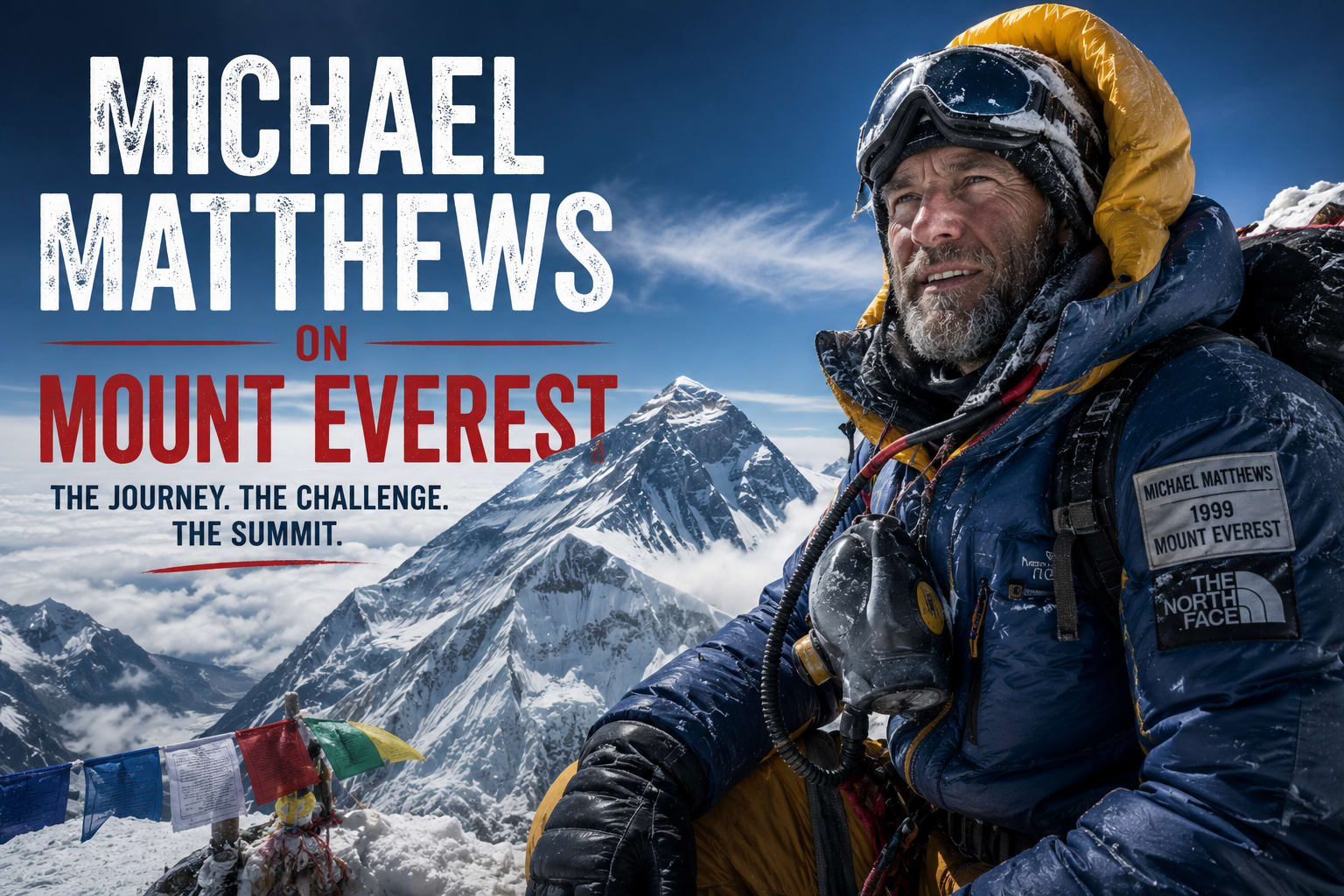
Michael Matthews became the youngest Briton to summit Mount Everest on 13 May 1999, aged 22. Roughly three hours into his descent, he disappeared in a violent storm near the Balcony on Everest's southeast ridge and was never seen again. His body has never been found — not even during a high-profile 2022 recovery mission led by record-breaking mountaineer Nims Purja, documented in the 2023 Disney+ film Finding Michael.
Below, we explain who Michael was, what went wrong on summit day, the legal battle that followed, and what his brother Spencer's search actually uncovered.
Who Was Michael Matthews?
Michael Matthews was a 22-year-old British climber and City of London trader. Born in 1977, he grew up in a family that loved the outdoors, and by his early twenties he had already climbed in the Alps and the Pyrenees and stood on top of Kilimanjaro.
Everest was the natural next step. In spring 1999, Michael joined a commercial expedition with OTT Expeditions (Out There Trekking), a respected Sheffield-based operator, reportedly paying around £25,000 (about $40,000 at the time) for a fully guided climb.
He is remembered by friends and family as warm, easy-going, and quietly determined — the kind of person who took on big challenges without making a fuss about them.
Key facts at a glance:
- Age at summit: 22 — the youngest Briton to reach the top at that time
- Summit date: 13 May 1999
- Route: South Col route (Nepal side)
- Expedition: OTT Expeditions
- Status: Missing; presumed dead. Body never recovered.
Summit Day: 13 May 1999
Michael reached the summit of Everest around midday on 13 May 1999 alongside guide Mike Smith. It was the proudest moment of his life — and it lasted only hours.
The weather deteriorated fast on the descent. Wind and blowing snow reduced visibility to almost nothing as the climbers made their way back down the southeast ridge toward the Balcony, a small platform at roughly 8,400 metres where climbers often change oxygen bottles.
Somewhere between the summit and the Balcony, Michael and his guide became separated in white-out conditions. Smith waited at the Balcony, but Michael never appeared. With his own life in danger, Smith eventually had to continue down. Michael was never seen again.
He became the 162nd person known to die on Everest. Later reports described what he was wearing — a red North Face down suit with black trim and black One-Sport boots — details that would matter years later, when searchers tried to identify bodies on the mountain.
How Did Michael Matthews Die?
No one knows for certain, and that uncertainty is a big part of why the story still resonates. What is known:
- He was exhausted. Michael had struggled on the way up, and at least one Sherpa on the team had advised him to turn back before the summit.
- He was descending through a severe storm in the Death Zone — the region above 8,000 metres where the body is slowly dying from lack of oxygen, and where judgment, coordination, and vision all deteriorate.
- Questions were later raised about the expedition's oxygen equipment, which some team members claimed did not perform as promised.
The most likely explanations are that Michael, disoriented by exhaustion, hypoxia, and zero visibility, either fell from the ridge or was blown off course and succumbed to the conditions. Because his body was never found, none of this can be confirmed.
The Aftermath: Lawsuits and a Landmark Court Case
This is the part of the story most retellings skip — and it changed the commercial climbing industry.
Michael's father, David Matthews, refused to accept the death as simple bad luck. His own investigation focused heavily on the expedition's oxygen system, which combined regulators and bottles from different suppliers — including refilled cylinders — a setup the family alleged was defective.
The family issued High Court writs against OTT, the expedition leader, the guide, and the oxygen supplier, alleging failures in guiding, equipment, and duty of care. The dispute later escalated into an unprecedented criminal prosecution heard at Southwark Crown Court in 2006 — the first time an Everest client's death had put the commercial expedition industry itself on trial in a British courtroom. The case ultimately did not produce convictions, but it forced a public reckoning with an uncomfortable truth David Matthews summed up bluntly: above 8,000 metres, there are no police, and no one is truly accountable.
For anyone researching guided Everest climbs today, this case remains a touchstone in debates about client screening, equipment standards, and guide responsibility.
Timeline of Key Events
Date | Event |
13 May 1999 | Michael summits Everest at 22; disappears on descent near the Balcony |
1999–2000 | Family investigates; legal action begins against OTT and others |
2006 | Landmark criminal case heard at Southwark Crown Court |
2017 | Family receives a photo of a body on Everest, possibly Michael's |
Spring 2022 | Spencer Matthews and Nims Purja mount a search expedition |
March 2023 | Finding Michael released on Disney+ (UK) and Hulu (US) |
Spencer Matthews and the Search for His Brother
Spencer Matthews — TV personality, entrepreneur, and Michael's youngest brother — was only ten when Michael died. He grew up in the shadow of the loss, and in 2017 the family received something that reopened everything: a photograph of a body high on Everest that might have been Michael.
In spring 2022, Spencer travelled to Nepal to lead a recovery mission — departing just days after his wife, Vogue Williams, gave birth to their third child. On the advice of family friend Bear Grylls (an executive producer on the project), Spencer stayed at Base Camp and coordinated the operation rather than climbing himself.
The search itself was led by Nirmal "Nims" Purja, the Nepali-British mountaineer famous for climbing all fourteen 8,000-metre peaks in under seven months. Key facts about the operation:
- A roughly 10-person high-altitude team searched above 8,000 metres, supported by drone pilots scanning terrain no human could safely reach.
- The 2017 photograph was identified early on — local Sherpas recognised the body as an Indian climber, not Michael.
- The team made two separate pushes into the Death Zone, checking bodies against descriptions of Michael's clothing and gear.
- Despite finding several bodies, none matched. Michael remains on the mountain.
A Different Kind of Closure: Wang Dorchi Sherpa
Before the search concluded, Spencer made a decision that gave the mission its most moving outcome. Knowing the odds of finding Michael were slim, he asked the family of Wang Dorchi Sherpa — a local climber who had died near Camp Four in May 2021 and whose family could not afford a recovery — whether they would want his body brought home if Michael could not be found.
Because Wang Dorchi's location was known, Nims' team was able to recover him and return him to his mother and brother for funeral rites. One family's search ended by giving another family the goodbye they couldn't otherwise have had.
Finding Michael: The Documentary
Finding Michael (2023) tells this story on screen. Essentials:
- Where to watch: Disney+ in the UK and internationally; Hulu in the US.
- Runtime/format: Feature-length documentary produced by Shine TV, with Bear Grylls as executive producer.
- What it covers: Michael's story, the 2017 photograph, the 2022 search led by Nims Purja, and the recovery of Wang Dorchi Sherpa.
- Reception: Reviews were mixed — praised for its extraordinary mountain footage and the Sherpa team's skill, while some critics questioned the ethics of filming body searches. The debate itself became part of the film's cultural impact.
Fair warning: the film includes footage some viewers will find distressing.
Why Do Bodies Stay on Everest?
Michael's story raises a question many readers ask: why can't bodies simply be brought down?
The answer is the Death Zone. Above 8,000 metres, oxygen levels are about a third of those at sea level. Climbers can barely carry themselves, let alone a frozen body that may weigh well over 100 kg with ice and gear. Recovery typically requires a team of six to ten elite Sherpas, costs tens of thousands of dollars, and puts every rescuer's life at risk. That's why an estimated 200+ bodies remain on the mountain — and why Spencer's expedition, with all its funding and expertise, still came home without Michael.
Michael's Legacy
Michael Matthews' record as the youngest Briton on Everest has since been surpassed, but his story endures for different reasons. The legal fight his family waged pushed hard questions about safety standards in commercial mountaineering. The documentary introduced his story to millions. And in his name, the Matthews family has supported charitable work in education — a quieter, longer-lasting kind of summit.
Frequently Asked Questions
Was Michael Matthews' body ever found? No. Despite the 2022 search expedition led by Nims Purja, Michael's body has never been located. He is believed to lie somewhere between the summit and the Balcony on Everest's southeast ridge.
How old was Michael Matthews when he died? He was 22, making him the youngest Briton to summit Everest at the time of his climb in May 1999.
Is Spencer Matthews related to Michael Matthews? Yes. Spencer Matthews, known from Made in Chelsea, is Michael's younger brother. He was ten years old when Michael died.
What happened in the Finding Michael documentary? Spencer coordinated a month-long search from Everest Base Camp while Nims Purja's team searched the Death Zone using drones and ground sweeps. They did not find Michael, but they recovered the body of Wang Dorchi Sherpa and returned it to his family.
Who was blamed for Michael Matthews' death? His family sued OTT Expeditions, its leaders, the guide, and the oxygen supplier, alleging negligence and defective oxygen equipment. A related criminal case was heard in London in 2006, but no one was ultimately convicted over his death.
Where can I watch Finding Michael? On Disney+ (UK and most international markets) and Hulu (US).
Is Michael Matthews still the youngest Briton to climb Everest? No. His 1999 record has since been broken, but he held it at the time of his death.
Conclusion
Michael Matthews' story is Everest in miniature: extraordinary achievement and devastating loss, separated by only a few hours and a few hundred metres of ridge. Twenty-seven years on, he remains on the mountain he dreamed of climbing — but through his family's fight for answers, his brother's search, and the film that documented it, his story continues to shape how people understand the world's highest peak.
Planning your own journey to the Everest region? You don't need to enter the Death Zone to stand in the shadow of the world's highest mountain. Explore our Everest Base Camp trek itineraries, read our guide to altitude safety, or get in touch and our local experts will help you plan a trip that's ambitious and safe.