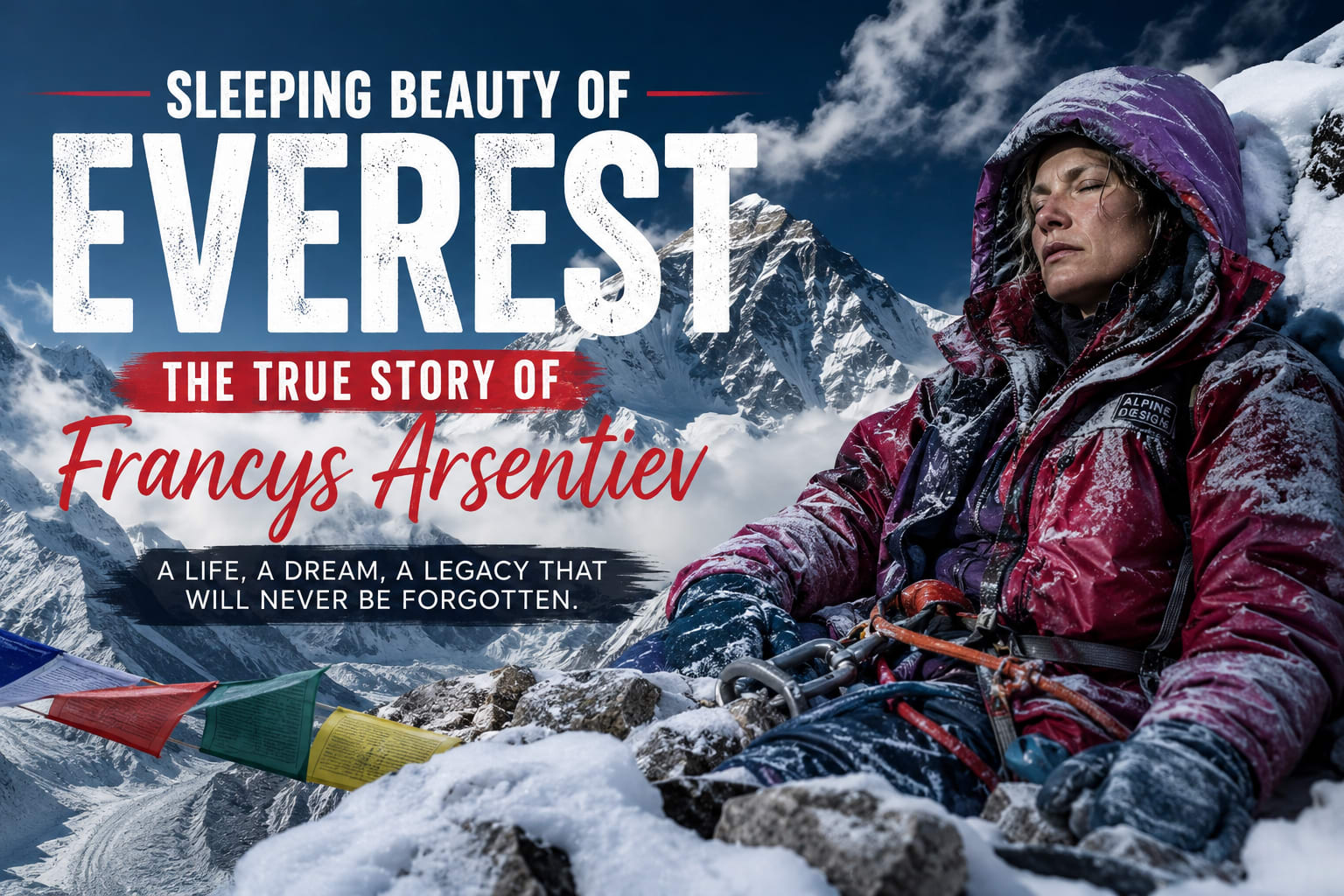
In May 1998, an American climber named Francys Arsentiev became the first woman from the United States to reach the summit of Mount Everest without bottled oxygen. Two days later, she died just below that same summit — and the way climbers found her gave rise to one of the most haunting nicknames in mountaineering history: the Sleeping Beauty of Everest.
Her body remained visible on the mountain's north side for nearly nine years, a quiet, sobering landmark for every climber who passed. This is the true story of who she was, what happened on her descent, and what eventually became of her.
Quick Facts: Francys Arsentiev
Full name | Francys Arsentiev (born Francys Yarbrough/Distefano) |
Born | January 18, 1958 |
Died | May 24, 1998, on Mount Everest, aged 40 |
Nationality | American |
Known for | First American woman to summit Everest without supplemental oxygen |
Summit date | May 22, 1998 |
Husband | Sergei Arsentiev, Russian mountaineer nicknamed "the Snow Leopard" |
Son | Paul Distefano |
Nickname | "Sleeping Beauty of Everest" |
Body recovered/moved | 2007, during the "Tao of Everest" expedition |
Who Was the Sleeping Beauty of Mount Everest?
The "Sleeping Beauty" is the nickname climbers gave to the body of Francys Arsentiev after she died high on Everest's north side. She wasn't a professional mountaineer by trade — she worked in finance before mountaineering became her calling — but by the late 1990s she was one of the most accomplished high-altitude climbers of her generation, with ascents of Denali, Pik Lenin, and Mount Elbrus (where she also became the first American woman to ski from the summit) already behind her.
She married Russian climber Sergei Arsentiev in 1992, three years after the two met on Annapurna. Sergei had already earned the nickname "the Snow Leopard" for climbing all five of the former Soviet Union's peaks above 7,000 meters — a rare and demanding feat. Together, the couple set their sights on a goal that had never been achieved: an American woman summiting Everest without supplemental oxygen.
That decision — to climb the world's highest mountain on nothing but her own lungs — is central to understanding both her triumph and her death.
The Climb: Timeline of the 1998 Expedition
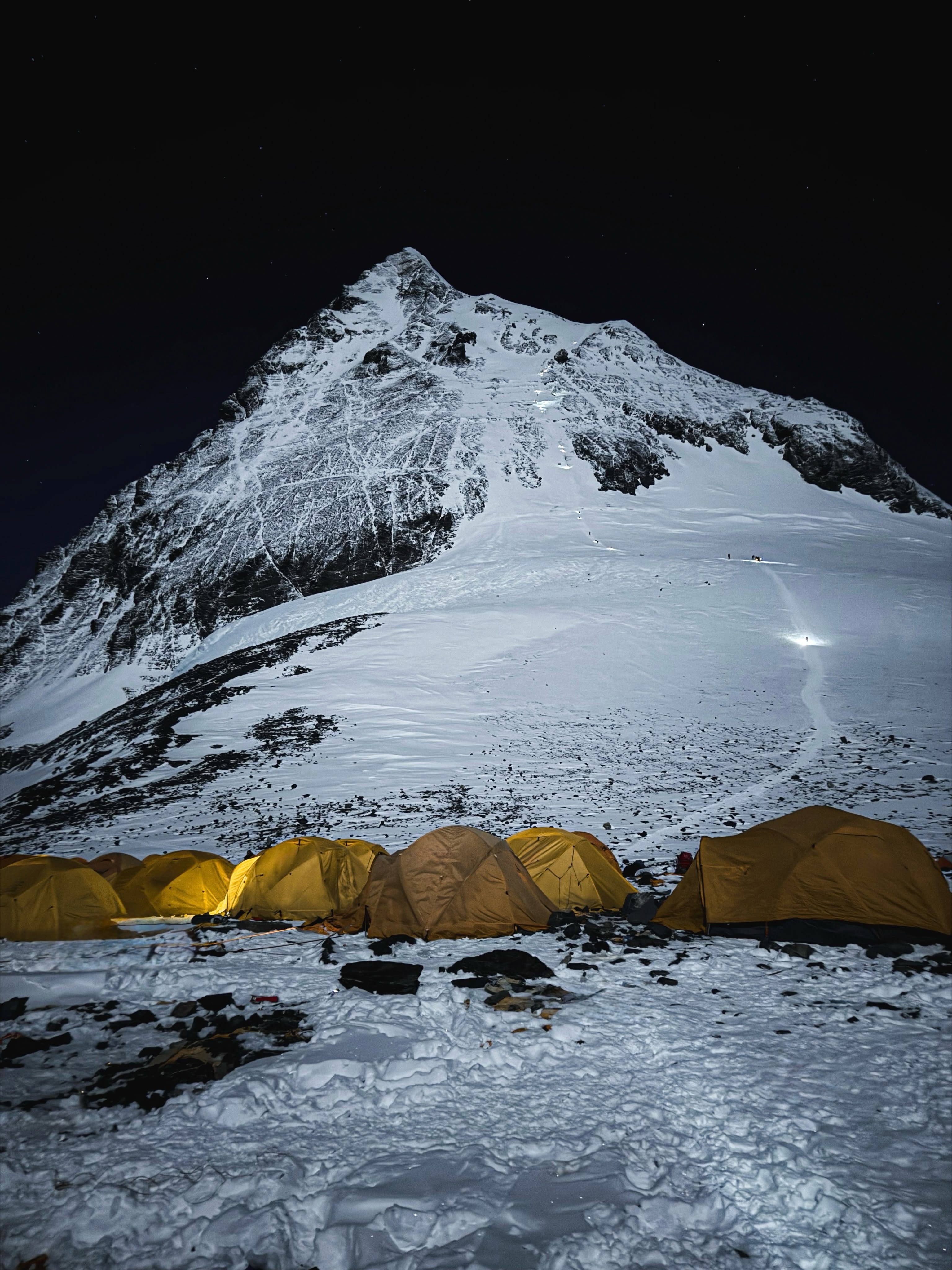
Francys and Sergei approached Everest from the north side in Tibet, the classic route used by Mallory and generations of climbers since. Climbing without bottled oxygen meant moving far slower than most expedition teams, and it meant spending extended time in the "Death Zone" above 8,000 meters, where the human body cannot properly acclimatize and slowly begins to shut down.
Their attempt didn't go smoothly from the start:
- Mid-May 1998 – The couple made two earlier attempts on the summit that were turned back by weather and exhaustion.
- May 20–21 – Climbing from Camp 6, they lost their headlamps and were forced back after gaining only a short distance.
- May 22, 1998 – On their third attempt, Francys and Sergei reached the summit. Because they had no supplemental oxygen, their pace throughout the day was slow, and they summited dangerously late — a decision that would leave them with almost no margin for the descent.
Reaching the top made Francys Arsentiev the first American woman ever to stand on Everest's summit without bottled oxygen. It remains one of the most difficult achievements in mountaineering.
The Descent That Turned Fatal
Summiting late meant Francys and Sergei were caught descending after dark, exhausted, oxygen-deprived, and navigating one of the most exposed sections of the mountain in failing light. At some point during the night, the couple became separated.
Sergei made it back down to their high camp the next morning — but Francys never arrived. Rather than rest, he immediately turned back up the mountain, carrying oxygen and medicine, to search for his wife. It was an extraordinary act of devotion, and it cost him his life. His body wasn't found until the following year, in 1999, by climber Jake Norton — part of the same expedition that famously located George Mallory's remains. The evidence suggested Sergei had fallen while trying to reach Francys in the dark.
On the morning of May 23, an Uzbek climbing team encountered Francys near the summit ridge. She was barely conscious, suffering from severe frostbite and oxygen deprivation, but still alive. Later that day, South African climbers Ian Woodall and Cathy O'Dowd found her lying on the exposed slope, still clipped into the fixed rope. They abandoned their own summit attempts and spent over an hour trying to help her, but at more than 8,500 meters, in freezing wind, with a climber who could no longer stand or descend under her own power, there was nothing more they could do. Carrying her down was not physically possible without risking the lives of the entire team.
They were forced to leave her. She died shortly afterward, still clipped to the rope, on May 24, 1998.
Her reported final words, spoken to the climbers who tried to help her, were simple and devastating: "Don't leave me."
Why Is She Called the "Sleeping Beauty" of Everest?
The nickname came directly from how climbers found her body in the years that followed. Francys was left lying on her side, eyes closed, her purple jacket and climbing gear intact, in a posture that looked less like death and more like rest. For nearly nine years, every climber attempting the north side route from Tibet passed within feet of her — a fixture on the mountain that became known, grimly, as the Sleeping Beauty.
It's a nickname born of respect as much as horror. Climbers who encountered her described her expression as peaceful, which is part of why the name stuck rather than something more clinical.
Rainbow Valley: Where Does the Name Come From?
"Rainbow Valley" is a nickname used by climbers for a section of Everest's upper slopes — mainly on the north side, near the notorious Second Step — where the bodies of climbers who never made it home lie among decades of abandoned climbing gear. The name isn't a tribute to natural scenery. It refers to the discarded oxygen bottles, tents, ropes, and brightly colored down suits scattered across the terrain, which, from a distance, create an eerie patchwork of color against the snow and ice.
Francys Arsentiev died in this general high-altitude zone, which is part of why her story and the name "Rainbow Valley" are so often mentioned together. It isn't an official place name on any map — it's climbers' shorthand for one of the most dangerous, and most littered, stretches of the world's highest mountain.
Is the Sleeping Beauty Still on Mount Everest?
Not visibly, no. For almost a decade, Francys Arsentiev's body remained in plain sight of climbers on the standard north route — a fact that weighed heavily on Ian Woodall, one of the two climbers who had been forced to leave her in 1998.
In 2007, Woodall organized and led an expedition called "Tao of Everest," with the explicit goal of finally giving Francys a measure of dignity. His team located her body, performed a brief ritual, wrapped her in an American flag, and moved her to a location just off the main climbing route, out of sight of passing expeditions. The same expedition also relocated the body of "Green Boots," another long-visible landmark on the north side.
Her body was not brought down off the mountain — at that altitude, recovery is extraordinarily dangerous and rarely attempted for that reason. Instead, she was laid to rest on the mountain she'd died trying to leave, finally out of view.
Sergei and Paul: What Happened to Her Family
Sergei Arsentiev's death a year after Francys, discovered in 1999 lower on the same face, closed the loop on one of Everest's saddest mysteries. He had summited without oxygen alongside his wife, then turned around into the Death Zone a second time to try to save her — a decision that cost him his own life.
Their son, Paul Distefano, was 11 years old when his parents died within a day of each other on the other side of the world. For nearly nine years afterward, photographs of his mother's body circulated publicly as one of Everest's most recognizable — and most debated — images, long before Woodall's 2007 expedition moved her from view.
The Larger Lesson of Francys Arsentiev's Story
Francys Arsentiev's story is frequently cited in discussions of Everest's unwritten rule of self-preservation above 8,000 meters: in the Death Zone, rescue is often physically impossible, and climbers who become immobile are, in most cases, beyond help. Cathy O'Dowd later wrote candidly about the impossible calculus she and Woodall faced — that carrying an incapacitated climber down from that altitude would have required dozens of people and days most expeditions simply don't have.
It's also a story about what people are willing to risk for the people they love, and about how quickly a historic achievement — the first American woman to summit without oxygen — can be overshadowed by tragedy on the way back down. Modern Everest climbers still talk about her descent as a case study in why turnaround times, supplemental oxygen decisions, and realistic pacing matter as much as reaching the top.
Frequently Asked Questions
Who is the Sleeping Beauty on Mount Everest? The Sleeping Beauty is Francys Arsentiev, an American climber who died on May 24, 1998, during her descent from Everest's summit, two days after becoming the first American woman to reach the top without supplemental oxygen.
How did Francys Arsentiev die? She became separated from her husband during a late, oxygen-free descent, suffered severe frostbite and altitude sickness overnight above 8,000 meters, and was found alive but unable to move by climbers who could not safely bring her down. She died on the mountain shortly after.
Is the Sleeping Beauty still visible on Everest? No. Her body was moved out of sight of the main climbing route in 2007 during an expedition led by Ian Woodall, one of the climbers who had encountered her in 1998.
What is Rainbow Valley on Mount Everest? Rainbow Valley is climbers' nickname for a high-altitude stretch of Everest's north side, near the Second Step, littered with the colorful gear — and, in places, the remains — of climbers who died attempting the summit.
What happened to her husband, Sergei Arsentiev? Sergei went back up the mountain to search for Francys after reaching camp without her. He died during the attempt; his body was found in 1999.